

Little Giants: the history of Kei Cars
by Khi
Long before social media builds, midnight touge runs, and parking lots full of modified S660s, Japan had a problem.
It was 1949. The country was rebuilding. Money was scarce. Roads were narrow. Fuel wasn’t exactly flowing like before the war. Most people couldn’t afford a full-sized automobile, but they still needed a way to move themselves, their families, and their businesses.
Japan’s answer arrived with the creation of a new vehicle class called Kei Jidōsha. Literally, “light automobile.”
Somewhere in the hills above Horizon Japan, long before the parking lots fill with GT-Rs and Supras, a tiny engine can be heard climbing through the fog. It sounds busy. Determined. Slightly offended by the laws of physics…
A few moments later, a kei car appears around the corner carrying crazy amounts of speed. Nobody is laughing.
Every Horizon club has at least one member who arrived in a kei car and spent the rest of the morning embarrassing machinery with twice the cylinders and three times the displacement. The veterans have seen it happen enough times that they stop looking at horsepower figures and start paying attention to the driver.
That reputation wasn’t built overnight. It took decades.
Kei cars were defined by government restrictions. Engine and size limits evolved over the years, eventually settling into the regulations enthusiasts know today: compact dimensions and engines capped at 660cc.
What began as practical transportation eventually became something much more interesting.
Manufacturers discovered that strict limitations often inspire creativity.
By the 1980s and early 1990s, Japan entered what many enthusiasts now regard as the golden age of performance kei cars.
The roads around Horizon still carry evidence of that era.
You see it in old photographs taped inside garages. You see it in faded club stickers on workshop toolboxes. Most of all, you see it whenever a small convertible or gullwing coupe arrives at a meet and immediately attracts a crowd.
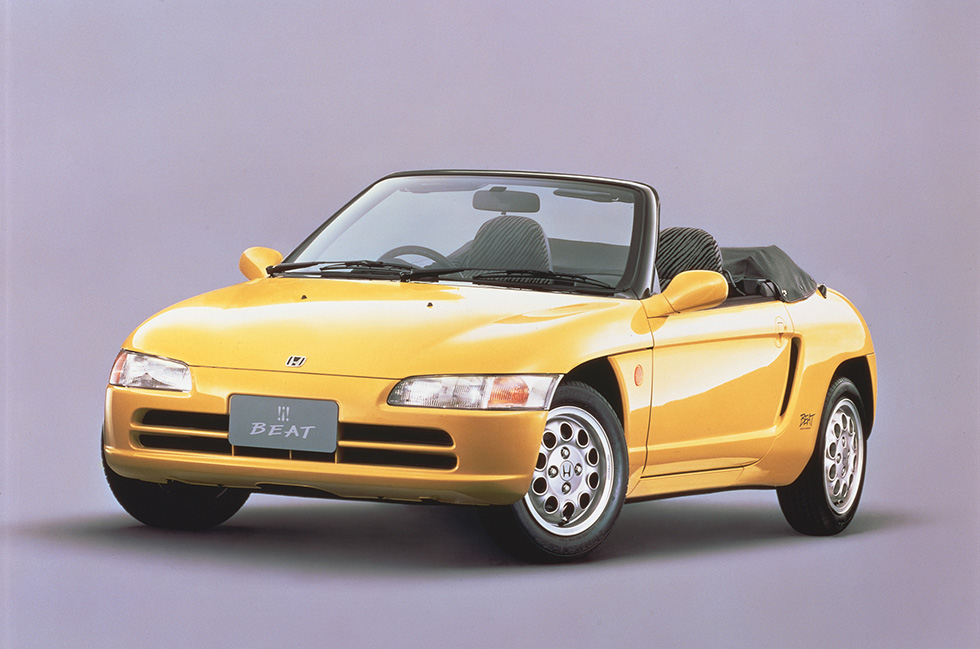
The Honda Beat remains one of the most beloved examples. Released in 1991, the Beat arrived with a mid-engine layout, rear-wheel drive, and one of the most enthusiastic engines Honda ever installed in a production car. Its naturally aspirated 656cc three-cylinder produced the maximum power allowed under kei regulations at the time: 64 horsepower.
Those numbers sound modest until the tachometer swings toward 8,000 rpm.
The Beat never feels interested in winning specification arguments. Its reputation comes from the way it attacks a mountain road. Even today, Horizon drivers talk about the car’s willingness to carry momentum through corners while larger, more powerful cars spend their time slowing down and accelerating again.
Honda wasn’t alone.

That same year brought the Suzuki Cappuccino, another future icon. While the Beat placed its engine behind the driver, Suzuki followed a more traditional formula with a front-engine, rear-wheel-drive layout. Lightweight construction and near-perfect balance made the Cappuccino a favorite among enthusiasts who valued precision over outright speed.
A generation later, its influence remains visible at club meets throughout Horizon Japan. Every gathering seems to have at least one owner explaining suspension modifications while another driver insists the car was already perfect from the factory.
Then there was the Mazda AZ-1.
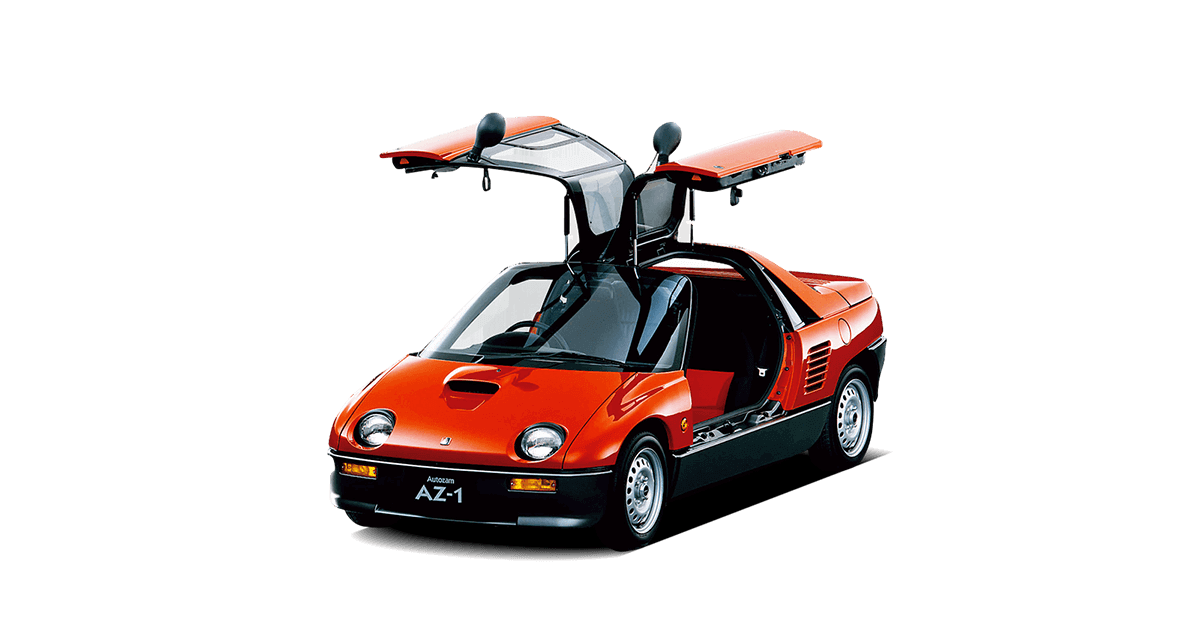
Even among kei cars, the AZ-1 felt unusual.
Introduced in 1992, Mazda’s tiny sports car featured a mid-engine layout and dramatic gullwing doors that looked more appropriate on an exotic supercar than a vehicle shorter than many modern hatchbacks. Children pointed at them. Adults did too.
The AZ-1 became proof that Japanese manufacturers were willing to have fun with the kei formula. Practicality still mattered, but imagination clearly received a seat at the design meeting.
Several other legends helped define the era.
The Autozam AZ-1’s mechanical cousin, the Suzuki Cara, appeared in limited numbers. Daihatsu offered the charismatic Copen years later, bringing open-top motoring back into the kei spotlight. Subaru’s Vivio earned a reputation for surprising performance, particularly in motorsport. The supercharged Vivio RX-R remains a favorite among enthusiasts who appreciate unlikely heroes.
 Even cars that technically sat outside modern kei regulations helped shape the culture surrounding them.
The Honda City II became a cult favorite during the 1980s. Larger than a kei car but sharing the same philosophy of maximizing fun within compact dimensions, the City developed a loyal following that still overlaps heavily with today’s kei community. Spot one at a Horizon meet and you’ll usually find a crowd discussing old magazine articles and long-forgotten tuning parts.
The 1990s also produced machines like the Daihatsu Mira TR-XX Avanzato and Suzuki Alto Works. These turbocharged pocket rockets transformed ordinary commutes into something far more entertaining. They demonstrated that performance could emerge from intelligent engineering rather than displacement alone.
Their influence extended well beyond Japan.
Today, enthusiasts around the world import kei cars for reasons that have very little to do with practicality. The appeal comes from personality. Modern performance cars often chase larger numbers, larger dimensions, and larger expectations. Kei cars travel in the opposite direction.
The limitations became their identity.
That philosophy fits naturally within Horizon culture.
Spend enough time around the festival and you’ll notice that drivers rarely remember a run because someone had the highest top speed. They remember the unusual cars. They remember the driver who arrived in a Cappuccino and disappeared into the mountains before anyone could keep up. They remember spotting an AZ-1 under neon lights at a late-night meet. They remember hearing a Beat screaming toward redline somewhere beyond the next corner.
Those memories explain why kei cars remain important.
The category was created as an economic solution for postwar Japan. Along the way, it became one of the most creative chapters in automotive history.
On paper, they are tiny.
Out on the roads of Japan, they have spent decades proving that size and significance are two very different measurements.
Primary Sources
Honda Beat (Official Honda Archive)
Honda Beat Press Information (1991)
Mazda AZ-1 (Official Mazda 100th Anniversary Archive)
Suzuki Corporate History
Suzuki 100th Anniversary Historical Archive
Suzuki 100th Anniversary History
Japan Automobile Manufacturers Association (JAMA)
Historical and Enthusiast References
Honda Beat
Octane Magazine: Honda Beat Buying Guide
Toyota Automobile Museum Archive: Honda Beat
Suzuki Cappuccino
Octane Magazine: Suzuki Cappuccino Buying Guide
Suzuki Cappuccino Story Archive